
White glove collision repair refers to a premium service model that combines OEM-certified repair standards with concierge-level communication, transparent processes, and personalized customer care throughout the entire repair cycle. Unlike standard body shops, white glove facilities treat collision repair as a complete experience—not just a transaction—providing dedicated support, detailed documentation, and proactive updates from initial assessment through final vehicle return.
The term “white glove” gets used frequently in the collision repair industry, but what does it actually mean when a body shop describes their service this way? For vehicle owners comparing repair options after an accident, understanding the difference between marketing language and genuine service delivery matters significantly—especially when dealing with a high-value vehicle, complex ADAS systems, or simply expecting professional treatment during an already stressful situation.
White glove service in collision repair isn’t about luxury amenities or concierge parking. It’s about operational standards, technical expertise, and communication protocols that fundamentally change how repair work gets completed and how customers experience the process. This distinction becomes particularly important when evaluating whether premium collision repair justifies any difference in out-of-pocket costs, time investment, or insurance coordination.
What Defines Authentic White Glove Collision Repair?
The phrase “white glove” originates from formal service industries where attendants literally wore white gloves to handle valuable items with extreme care. In collision repair, this translates to a set of measurable service standards rather than subjective promises.
Authentic white glove collision repair includes:
Concierge style Services They provide vehicle pick-up and delivery to your home, school, or workplace.
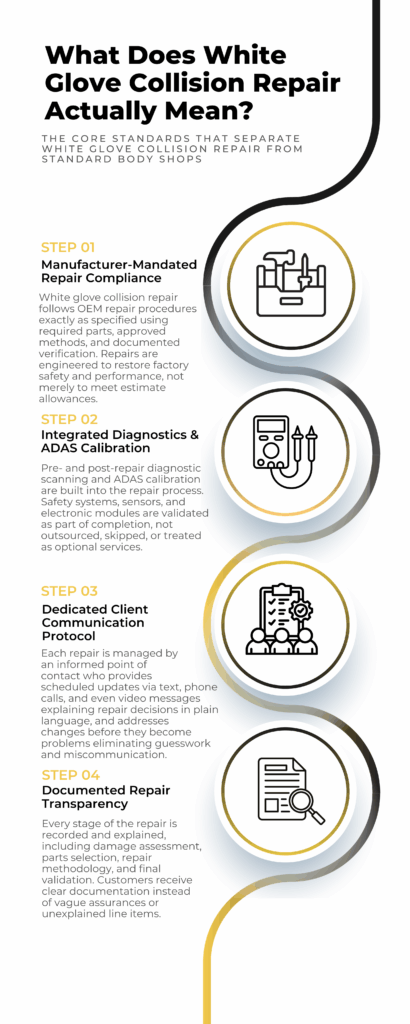
OEM-Certified Repair Processes Every repair follows manufacturer specifications exactly as written. This means using OEM parts when structurally required, following published repair procedures for specific vehicle models, and maintaining certifications across multiple manufacturers. Standard body shops may complete repairs competently, but white glove facilities document compliance with OEM standards for every repair decision. Repairs under white glove service meet or exceed factory specifications, using original equipment manufacturer (OEM) parts and high-quality finishes.
Dedicated Customer Liaison You receive a single point of contact throughout the entire repair process—not a rotating staff answering phones. This person knows your vehicle, understands your timeline, and proactively communicates progress without requiring you to call for updates.
Transparent Documentation White glove facilities provide detailed documentation including photo-documented damage assessment, explanation of repair methodology, parts sourcing verification, and post-repair quality validation. You’re not guessing what happened to your vehicle or trusting vague assurances.
Advanced Diagnostic Integration Modern vehicles require pre-repair and post-repair diagnostic scanning. White glove service includes this as standard protocol—not an upsold service. ADAS calibration, module programming, and system verification happen automatically based on the repair scope.
Proactive Insurance Coordination Rather than putting customers in the middle of estimate disputes, white glove facilities manage insurance communication directly, advocating for proper repair procedures while keeping customers informed about coverage decisions and timeline impacts.
Quality Assurance Protocol Before vehicle return, a formal quality inspection validates repair completion, paint finish, panel alignment, functionality of repaired systems, and interior cleanliness. This isn’t a quick visual check—it’s a documented validation process.
Why Does White Glove Service Matter for Collision Repair?
The collision repair industry operates on a spectrum. On one end, high-volume shops prioritize throughput and cost efficiency. On the other end, white glove facilities prioritize repair integrity and customer experience. Neither approach is inherently wrong, but they serve different customer needs and vehicle requirements.
For Modern Vehicle Technology Vehicles equipped with advanced driver assistance systems, adaptive cruise control, lane keeping assist, and automatic emergency braking require precise calibration after collision repair. Standard shops may outsource this work or skip necessary procedures to reduce cycle time. White glove facilities integrate ADAS calibration as a core competency, ensuring repaired vehicles maintain manufacturer safety performance.
For Insurance-Driven Repairs Insurance companies often steer customers toward preferred shops based on volume pricing agreements. White glove facilities typically don’t participate in these programs, maintaining independence to advocate for proper repair procedures even when insurance adjusters initially deny certain repair operations. This matters when dealing with structural damage, airbag deployment, or repairs affecting safety systems.
For Vehicles Under Warranty or Lease Manufacturer warranties and lease-return requirements often specify OEM repair procedures and parts. Using aftermarket components or non-certified repair methods can void warranties or trigger lease-end penalties. White glove shops document OEM compliance to protect warranty coverage.
For Resale Value Protection Comprehensive repair documentation and OEM certification maintain vehicle history transparency. When selling a previously damaged vehicle, documented evidence of manufacturer-spec repairs significantly impacts resale value compared to generic body shop invoices.
When Does White Glove Service Matter Most After an Accident?
The value of premium collision repair becomes most apparent in specific situations:
Complex Structural Damage Frame straightening, unibody repair, and structural reinforcement require precise measurement and OEM methodology. White glove facilities use manufacturer-approved measuring systems and follow published structural repair procedures without shortcuts.
Multiple System Involvement When collision damage affects multiple vehicle systems—suspension, electrical, safety, or powertrain—coordinated diagnosis and repair becomes critical. White glove service includes comprehensive system validation rather than addressing only visible damage.
High-Value Vehicles Luxury, exotic, and high-performance vehicles often require specialized repair techniques, proprietary parts, and manufacturer-specific tooling. White glove facilities maintain certifications for these brands and invest in required equipment. Technicians providing white glove services are often highly trained and certified, particularly for luxury and exotic vehicles.
Time-Sensitive Situations Paradoxically, white glove service can reduce total repair time despite more thorough processes. Proactive parts ordering, pre-scheduled ADAS calibration, and streamlined insurance coordination prevent common delays that extend repair cycles at standard shops.
Insurance Disputes When insurance adjusters contest repair necessity or attempt to substitute aftermarket parts inappropriately, white glove facilities provide technical documentation and manufacturer justification to support proper repair procedures.
What White Glove Service Includes at Every Stage
Understanding what premium service delivers throughout the repair process helps evaluate whether specific shops actually provide white glove standards or simply use the terminology.
Initial Contact and Assessment
Standard process: Customer calls, provides basic information, scheduled for drop-off estimate.
White glove process:
- Direct phone answer by knowledgeable staff (not voicemail routing)
- Preliminary damage assessment via photo review if provided
- Proactive scheduling that accommodates customer availability
- Clear explanation of what to bring (insurance information, lease documents, personal items to remove)
- Coordination of rental vehicle if needed before appointment
Damage Documentation
Standard process: Visual inspection, estimate written based on visible damage.
White glove process:
- Complete photo documentation of all damage angles
- Pre-repair diagnostic scan to identify hidden system damage
- Detailed estimate with line-item explanations
- Identification of parts requiring OEM specification vs. suitable alternatives
- Initial timeline projection with explanation of variables
Repair Authorization
Standard process: Estimate sent to insurance, customer waits for approval.
White glove process:
- Estimate submitted with supporting documentation for contested items
- Customer receives copy with plain-English explanation of repair scope
- Proactive communication about supplement likelihood and process
- Clear authorization for customer-pay items if applicable
- Confirmation of deductible and payment arrangements
During Repair
Standard process: Customer calls for updates, receives generic “still working on it” responses.
White glove process:
- Scheduled progress updates without customer needing to call
- Photo documentation of repair stages if requested
- Immediate notification of timeline changes or supplement requirements
- Parts sourcing transparency (OEM vs. aftermarket, availability delays)
- Proactive problem-solving rather than passing issues to customer
Quality Validation
Standard process: Repair completed, vehicle cleaned, ready for pickup.
White glove process:
- Multi-point quality inspection using documented checklist
- Post-repair diagnostic scan to verify system functionality
- Paint depth measurement and cure validation
- ADAS calibration confirmation and test drive
- Detail cleaning including removal of overspray protection materials
- Final photo documentation of completed repair
Vehicle Return
Standard process: Customer picks up vehicle, signs paperwork, leaves.
White glove process:
- Scheduled pickup appointment (not “anytime during business hours”)
- Detailed walkthrough of completed repairs
- Explanation of warranty coverage and care instructions
- All documentation provided in organized format
- Follow-up call scheduled for one week post-delivery
- Clear point of contact for any post-repair concerns
White Glove vs. Standard Collision Repair: Service Level Breakdown
Here’s how white glove service standards compare to typical collision repair across key touchpoints:
| Service Element | Standard Collision Repair | White Glove Collision Repair |
| Initial Contact | Voicemail or rotating staff | Direct liaison assignment |
| Damage Assessment | Visual inspection only | Photo-documented + diagnostic scan |
| Estimate Detail | Line-item parts list | Explanation of repair methodology |
| Parts Sourcing | Aftermarket preference | OEM compliance documented |
| Insurance Coordination | Customer relays information | Direct facility-to-adjuster communication |
| Repair Updates | Customer calls for status | Proactive scheduled updates |
| ADAS Calibration | Outsourced or omitted | In-house capability, included |
| Quality Inspection | Visual check before pickup | Multi-point documented validation |
| Post-Repair Support | “Call if you have issues” | Scheduled follow-up contact |
| Warranty | 90 days to 1 year | Lifetime on workmanship (typical) |
How to Identify Genuine White Glove Service
Marketing claims don’t validate actual service delivery. When evaluating collision repair facilities, specific indicators reveal whether white glove standards exist:
Single Point of Contact Confirmation Ask whether you’ll work with one dedicated person throughout the repair. If the answer involves “our team” or “whoever answers,” the facility doesn’t maintain white glove communication standards.
Documented Process Explanation Request information about diagnostic scanning protocol, ADAS calibration capability, and quality validation procedures. White glove facilities explain these processes clearly because they’re standard operating procedure, not upsold services.
Transparent Timeline Discussion Premium service doesn’t necessarily mean faster repair, but it does mean honest timeline projection. Beware of shops promising completion dates before damage assessment or diagnostic scanning.
Insurance Relationship Clarity Ask whether the facility participates in insurance direct repair programs. Neither answer is wrong, but understanding the relationship clarifies whether the shop maintains repair advocacy independence or prioritizes insurance partnership.
Facility Investment Evidence White glove service requires equipment investment. Look for evidence of frame straightening systems, spray booth quality, diagnostic scanning tools, and ADAS calibration targets. These aren’t items that can be faked easily.
What White Glove Service Doesn’t Promise
Understanding what premium collision repair cannot guarantee helps set realistic expectations:
Lowest Price White glove facilities typically don’t compete on price. OEM parts cost more than aftermarket alternatives. Comprehensive diagnostic scanning adds expense. Dedicated customer liaison support requires staffing investment. These costs reflect operational standards, not profit padding.
Fastest Turnaround Thorough repair takes appropriate time. ADAS calibration can’t be rushed. Paint curing follows chemistry, not convenience. Insurance supplement negotiations occur on adjuster schedules. White glove service minimizes preventable delays but can’t eliminate necessary process time.
Insurance Approval Guarantee Even with proper documentation, insurance companies sometimes deny legitimate repair procedures. White glove facilities advocate for appropriate repairs and provide technical justification, but they cannot force insurance approval. They can, however, explain options when coverage disputes occur.
Zero Inconvenience Collision repair disrupts normal life regardless of service quality. White glove facilities minimize friction through proactive communication and rental coordination, but the fundamental inconvenience of vehicle damage remains.
Does White Glove Service Apply to All Repairs?
Not every collision repair requires or benefits from white glove service. Understanding when premium service matters most helps make informed decisions:
Minor Cosmetic Damage Small dents, scratches, or bumper scuffs on older vehicles may not justify premium service investment if OEM specifications and ADAS systems aren’t factors.
High-Mileage Vehicles Near End of Life If a vehicle has limited remaining value and won’t be kept long-term, comprehensive documentation and OEM compliance may not provide practical benefit.
Simple Repairs with Clear Scope Isolated damage with no structural involvement, system impact, or insurance complexity might not require white glove communication protocols.
However, white glove service becomes increasingly important for:
- Any vehicle with active driver assistance systems
- Repairs involving airbag deployment or structural damage
- Leased vehicles or those under manufacturer warranty
- High-value vehicles where resale documentation matters
- Complex repairs requiring insurance negotiation
- Situations where owner peace of mind justifies premium service investment
Why Communication Defines White Glove Service
Technical repair capability alone doesn’t create white glove service. The defining characteristic of premium collision repair is how facilities communicate throughout the process.
Proactive vs. Reactive Updates Standard shops respond when customers call. White glove facilities provide scheduled updates before customers need to ask. This distinction reduces customer stress and builds confidence in the repair process.
Plain-English Explanations Body shop jargon creates information asymmetry. White glove service includes translation of technical repair language into understandable explanations without condescension.
Bad News Delivery When supplements get denied, parts take longer than expected, or repairs reveal additional damage, how facilities communicate these setbacks distinguishes service quality. White glove standards include solutions with bad news, not just problems.
Empowered Customer Liaison The person communicating with customers must have authority to make decisions and access to real-time repair status. If your contact person constantly needs to “check with the shop” or “ask the manager,” white glove protocols aren’t in place.
What to Ask Before Choosing a Collision Repair Facility
When evaluating whether a shop provides genuine white glove service, these questions reveal operational reality:
- “Will I work with one specific person throughout my repair, and can I meet them before committing?” White glove answer: Yes, and here’s their contact information.
- “Do you perform pre-repair and post-repair diagnostic scanning on all repairs, or only when specifically requested?” White glove answer: Standard protocol on all repairs, included in estimate.
- “How do you handle ADAS calibration—in-house capability or outsourced?” White glove answer: In-house calibration for all systems we repair.
- “What manufacturer certifications do you currently maintain, and can I verify them?” White glove answer: Specific brand certifications listed with verification method.
- “How do you communicate repair progress, and how often should I expect updates?” White glove answer: Scheduled updates at specific intervals, plus immediate notification of timeline changes.
- “What happens if my insurance company and your facility disagree on repair procedures?” White glove answer: We provide technical documentation to support proper repair and explain your options clearly.
- “Can you explain your quality inspection process before vehicle return?” White glove answer: Multi-point documented inspection with specific validation steps.
The Economics of White Glove Collision Repair
Understanding cost structure helps evaluate whether premium service represents value or unnecessary expense.
Insurance Coverage Reality Most comprehensive collision insurance covers repair costs regardless of facility choice. Deductibles remain the same. The primary out-of-pocket difference often involves potential customer-pay items when insurance denies certain procedures.
When Cost Differences Appear
- OEM parts vs. aftermarket alternatives (insurance may not cover price difference)
- Rental vehicle duration if repair takes longer due to proper procedures
- Customer-elected services beyond insurance coverage scope
Value Protection Perspective White glove service documentation can preserve thousands in vehicle resale value and prevent tens of thousands in warranty claim denials. The incremental cost difference often represents insurance against larger future losses.
Total Cost of Ownership Improper collision repair can create ongoing problems: electrical gremlins, water leaks, wind noise, premature paint failure, and compromised safety systems. Re-repair costs often exceed the initial savings from choosing a lower-service facility.
Frequently Asked Questions
Does white glove collision repair cost more than standard body shop service? Insurance typically covers repair costs regardless of facility choice, so out-of-pocket expense often remains similar. Cost differences may appear when white glove facilities advocate for OEM parts or procedures that insurance initially denies, requiring customer decision about accepting coverage limitations or paying differences directly.
How much longer does white glove collision repair take compared to standard service? White glove service doesn’t inherently take longer—it follows proper procedures that standard shops should also complete. The perception of longer timelines often reflects honest communication about realistic completion dates rather than optimistic promises. Comprehensive diagnostic scanning and ADAS calibration may add 1-2 days compared to shops that skip these steps.
Can I use a white glove collision repair facility even if my insurance recommends a different shop? Yes. Insurance companies cannot require you to use specific repair facilities. You have the right to choose any licensed repair shop. Insurance must pay for proper repairs at your chosen facility, though they may initially contest certain procedures regardless of facility selection.
What makes ADAS calibration important in white glove collision repair? Modern vehicles use cameras, radar, and sensors for safety systems like automatic emergency braking and lane keeping assist. Even minor collision damage can misalign these sensors. White glove facilities include comprehensive ADAS calibration services to restore manufacturer safety performance, while standard shops may skip this step to reduce costs and cycle time.
How do I verify a collision repair shop actually provides white glove service? Look for specific manufacturer certifications (not just industry associations), ask to meet your dedicated customer liaison before committing, request explanation of diagnostic scanning and ADAS calibration protocols, and check whether the facility can articulate their quality inspection process in detail. Marketing claims don’t validate actual capability.
Does white glove service include a better warranty than standard collision repair? Many white glove facilities offer lifetime warranties on workmanship and structural repairs compared to 1-year standard warranties. More importantly, white glove documentation of OEM-compliant repairs preserves manufacturer vehicle warranties that could otherwise be voided by improper repair procedures.
Is white glove collision repair only for luxury or expensive vehicles? No. Any vehicle with modern safety systems benefits from white glove standards. ADAS calibration matters equally on a Honda Civic and a Mercedes S-Class. The value lies in repair integrity and communication quality, not vehicle price point. However, economic practicality means older high-mileage vehicles may not justify premium service investment.
Ready to Experience True White Glove Service?
If you’re evaluating collision repair options and want to understand what genuine white glove service looks like in practice, we’re here to help. Schedule your free estimate or book an appointment to speak with one of our dedicated customer liaisons about your specific repair needs.